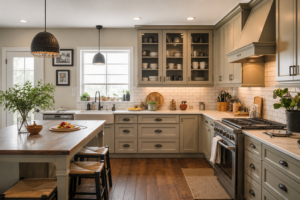
If your cabinet boxes are structurally solid and you like your current kitchen layout, cabinet refacing wins it costs 50–70% less and takes days, not weeks. If your boxes are warped, damaged, or you need a new layout, full replacement is the right call. Use our instant calculator below to get a real estimate for your San Jose kitchen.
Cabinet refacing in San Jose is priced by the door, by the linear foot, or as a flat project rate. Based on current Santa Clara County contractor data, expect the following ranges in 2025:
| Refacing Method | Cost Range (San Jose) | Best For | Durability |
|---|---|---|---|
| RTF / Thermofoil Doors | $4,000 – $7,000 | Budget-conscious refresh | Moderate |
| Laminate / Plastic Doors | $5,000 – $9,000 | Colour variety, urban homes | Moderate–Good |
| Real Wood Veneer Doors | $8,000 – $14,000 | Premium finish, resale prep | High |
| Per Door (San Jose) | $160 – $230 per door | Reference pricing | — |
| Per Linear Foot (San Jose) | $180 – $310 per linear foot | Reference pricing | — |
Full cabinet replacement in San Jose involves removing existing cabinetry and installing new units. Cost varies enormously based on whether you choose stock, semi-custom, or fully custom cabinets. Most San Jose kitchens require 20–30 linear feet of cabinetry.
| Cabinet Type | Per Linear Foot (Installed) | 20 Lin Ft Kitchen | 30 Lin Ft Kitchen |
|---|---|---|---|
| Stock Cabinets | $100 – $300 | $2,000 – $6,000 | $3,000 – $9,000 |
| Semi-Custom Cabinets | $150 – $650 | $3,000 – $13,000 | $4,500 – $19,500 |
| Custom Cabinets (San Jose) | $500 – $1,500 | $10,000 – $30,000 | $15,000 – $45,000 |
| High-End Custom / Luxury | $1,500+ | $30,000+ | $45,000+ |
Bay Area Labour Premium:
San Jose labour rates run 25–35% above the national average. A cabinet project quoted at $15,000 nationally may run $19,000 $20,000 here. Always get an on-site estimate online calculators using national data will underestimate your project cost.
| Neighbourhood | Typical Home Era | Cabinet Condition | Typical Best Choice |
|---|---|---|---|
| Willow Glen | 1930s–1970s | Solid plywood boxes, structurally excellent, finish outdated | Refacing |
| Almaden Valley | 1975–1995 | Mix — solid boxes in well-maintained homes, particle board in others | Assess First |
| Evergreen | 1980s–1990s | Often particle board from this era — condition varies widely | Assess First |
| Berryessa | 1960s–1980s | Older homes often have solid boxes — inspect for moisture damage | Often Refacing |
| Campbell | 1960s–1990s | Variable — assess condition; layout changes often desired | Assess First |
| Los Gatos | 1950s–2000s | Higher-value homes — buyers expect quality; resale standards are high | Often Replacement |
| Saratoga | 1960s–1990s | Premium market — full replacement typical for resale and long-term stay | Replacement |
| Milpitas | 1970s–2010s | Older homes: assess boxes. Newer townhomes: builder-grade, refacing works | Assess First |
The right choice often depends on the era and type of home you’re in. Here’s how the decision typically plays out across San Jose’s main residential areas.
Many San Jose homeowners assume cabinet refacing is just painting the doors. It isn’t. A proper refacing project replaces or updates five key elements of your cabinets while leaving the structural box in place.
All cabinet doors
All drawer fronts
Visible cabinet box exteriors
Hinges and mounting hardware
Handles and pulls
Exposed cabinet box sides
Cabinet box structure
Interior shelving
Cabinet positioning and layout
Plumbing connections under sink
Electrical in cabinet areas
Existing countertop
💡 Common add-on:
Many San Jose homeowners combine cabinet refacing with quartz countertop replacement in a single project. The two together typically cost $9,000–$20,000 and produce a kitchen that looks fully renovated at roughly half the cost of a full remodel.
Condition of the Cabinet Boxes
Your Kitchen Layout Satisfaction
In San Jose’s competitive real estate market, kitchen quality is consistently cited by buyers as a primary decision factor. Both refacing and replacement add value — but the financial return picture is more nuanced than most people expect.
60–70% cost recovery on resale
Near 100% perceived-value ROI for pre-listing
Buyers rarely distinguish refaced from replaced
Strong ROI because cost basis is lower
Best value when boxes are solid plywood
Ideal in Berryessa, Evergreen, Willow Glen
70–80% cost recovery on resale
Higher absolute dollar return in premium markets
Custom storage features valued by serious buyers
Higher cost basis = larger initial investment
Best ROI in Los Gatos, Saratoga, Los Altos
Stronger long-term value for 10+ year owners
The real estate insight: most buyers see the kitchen’s overall appearance, not its construction method. A well-executed cabinet reface with real wood veneer, updated hardware, and new quartz countertops will look indistinguishable from a full replacement to the vast majority of San Jose buyers — at roughly half the cost.
❓ Frequently Asked Questions
No. Synthetic fabrics like polyester and nylon have low shrink risk in hot water. Natural fibers — cotton, wool, linen, silk — are most vulnerable. Always check your garment’s care label before choosing a wash temperature.
Cotton can shrink anywhere from 1% to 5% in a single hot wash, depending on whether it has been pre-shrunk and how high the water temperature is. Pre-shrunk cotton (often labeled “preshrunk”) has already been treated and is less likely to shrink further.
Warm water (85–105°F) can cause gradual shrinkage in natural fiber garments over multiple washes, but it’s far less aggressive than hot water. For most everyday fabrics, warm water is a safe middle ground.
You can sometimes restore cotton and blended fabrics by soaking them in lukewarm water with conditioner and gently stretching them back into shape. Wool that has felted cannot be restored. Prevention is always the better approach.
The cold or delicate cycle is safest for most garments. Cold water minimizes shrinkage, and the gentle cycle reduces physical abrasion on fabric fibers. For everyday loads, a warm wash (not hot) is a reasonable option for cotton blends and moderately soiled items.

Okasha Sammer is an SEO and copywriting expert who creates data-driven home remodeling content for San Jose homeowners. She specializes in turning complex renovation decisions into clear, helpful guides that rank and convert.